
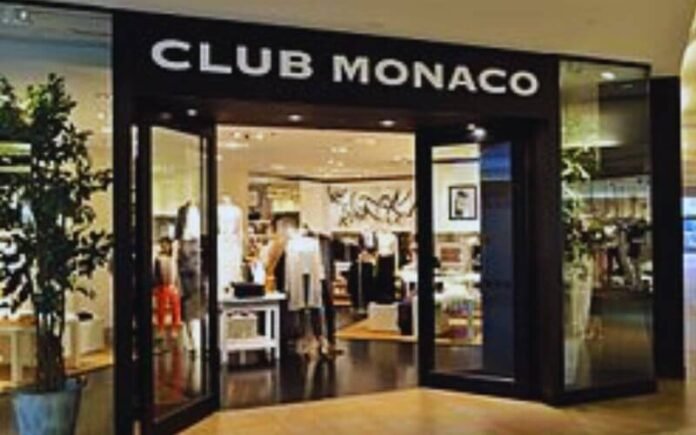
Club Monaco has shut down several well-known locations, received eviction notices, and been named in significant rent lawsuits. For longtime customers, that raises a fair question: is this brand finished?
The short answer is no but the longer answer is more complicated. Club Monaco is not bankrupt or shutting down entirely. What it is doing is shrinking, and doing so at a noticeable pace. This article breaks down what has actually happened, how many stores remain, and what shoppers need to know right now.
Club Monaco Is Not Bankrupt — But It Is Shrinking Fast
No formal bankruptcy filing or full liquidation has been reported for Club Monaco as of the latest available information. The brand’s website is still active, with current collections, a working checkout, and standard shipping. Its Instagram account continues to post new product and marketing content on a regular basis.
What is happening is a significant reduction in physical store locations. That is different from a company going out of business. It is worth being clear on this distinction: store closures, financial strain, and formal insolvency are three separate things. Club Monaco is dealing with the first two. There is no public evidence of the third.
That said, the scale of downsizing is real and worth paying attention to, especially for customers who relied on local stores.
A Canadian Brand With a Long History Now Under Private Investment Ownership
Club Monaco was founded in Toronto in 1985. It built a reputation for clean, minimalist clothing the kind of wardrobe basics positioned as accessible luxury without the full designer price tag.
At its peak, the brand operated more than 140 locations worldwide, spanning North America, Asia, the Middle East, and Europe. That figure now appears significantly outdated based on 2025 and 2026 reporting. The brand was previously owned by Ralph Lauren before being acquired by Regent, L.P., a private investment firm.
That ownership change matters when reading the current situation. Private investment firms often acquire retail brands with the goal of restructuring costs, exiting underperforming leases, and reducing the physical store footprint. It does not automatically mean the brand will disappear. But it does explain why aggressive store exits and cost-cutting have followed.
The Store Closures in Canada and the U.S. — What Has Actually Closed
The most symbolic closure was the original Club Monaco flagship on Queen Street West in Toronto. That store had been open for nearly 40 years. It quietly closed by December 2025. Local media described it as the “end of an era” for that stretch of the city’s fashion scene, and public reaction reflected genuine nostalgia for what the location had represented.
That was not the only Toronto closure. The Eaton Centre location shut down in June 2025. The Yorkdale men’s store followed in the fall of 2025. By early 2026, only four Club Monaco locations remained in Ontario: Sherway Gardens, Yorkdale, Square One, and Promenade.
Across Canada, approximately 14 locations remained as of late 2025, according to reporting from Retail Insider. Most of those are in shopping malls. The Sainte-Catherine Street store in Montreal stands as the last remaining street-front Club Monaco in the entire country a notable detail given how many street-level retail spaces the brand once held.
The U.S. picture is similarly contracted. As of late 2025, the American footprint had narrowed to roughly five stores: Beverly Center and Beverly Hills in Los Angeles, two New York City locations, and Boston’s Prudential Center. Subsequent reporting indicates further closures after that, including the Boston Prudential location, bringing the U.S. count down even further.
Unpaid Rent, Evictions, and Lawsuits What the Legal Disputes Reveal
Two separate legal situations have drawn attention to Club Monaco’s financial position, and both deserve a straightforward explanation.
The Toronto Eviction Notice
In January 2026, the Club Monaco location at 2610 Yonge Street in Toronto received a formal eviction notice. The notice cited approximately CA$133,917 in unpaid rent. The lease was terminated and the locks were changed. The notice covered four storefronts spanning 2604 to 2610 Yonge Street.
This is a significant event. An eviction over unpaid rent signals that the brand was not keeping up with its lease obligations at that address. It suggests financial strain at the operational level, even if it does not confirm a broader collapse.
The New York Lawsuit
In August 2025, New York landlord RFR Holding filed a lawsuit against Club Monaco over more than US$800,000 in unpaid rent at 160 Fifth Avenue, a large Flatiron District store. Club Monaco had vacated the space on July 31, 2025, allegedly without settling outstanding base rent, deferred rent, and additional charges. The landlord sought approximately US$1 million in total, plus legal fees.
Taken together, these two cases tell a consistent story: Club Monaco has been exiting expensive urban leases, and in at least some cases, it has left without fully settling its financial obligations. That reflects a company under real cost pressure but it is still different from a company that has filed for bankruptcy or announced it is shutting down completely.
What This Means for Shoppers Right Now
If you are a Club Monaco customer, the most immediate practical reality is that your local store may already be gone, or may close soon. Physical shopping options are far more limited than they were even a year ago.
The brand’s online store at clubmonaco.com remains operational. Orders appear to be processing normally, and the site is actively promoting current collections alongside a sale section. For most customers, online will be the primary way to access the brand going forward.
If you have gift cards or store credits, it is worth checking the brand’s current terms directly on their website or contacting customer service. When a store closes a physical location, gift card and return policies can sometimes shift. Do not assume your local store’s closure automatically affects your online purchasing ability but verify before making a significant transaction.
The Bigger Picture: Why Mid-Tier Fashion Brands Are Struggling
Club Monaco’s situation is not unique. Dozens of mid-tier fashion retailers have faced similar pressure over the past several years. A few factors are driving it across the industry.
- High urban rents: Premium retail leases in cities like New York and Toronto carry costs that are increasingly hard to justify when foot traffic has not fully recovered to pre-pandemic levels.
- Online shopping: Consumers have shifted a larger share of their clothing purchases online, reducing the need for a broad physical store network.
- Increased competition: Fast fashion brands and direct-to-consumer labels have taken market share from mid-range retailers that cannot compete on price or speed.
Club Monaco is one of many retailers responding by doing less with more fewer stores, tighter inventory, and a heavier focus on digital channels. Brands like J.Crew have gone through bankruptcy and emerged with a smaller footprint and an ongoing online presence. That pattern is not a guarantee of what Club Monaco will look like in two years, but it shows that large-scale closures do not always mean permanent disappearance.
For more business coverage on retail trends, brand restructuring, and consumer finance, Daily Business Media covers these topics on a regular basis.
How to Tell the Difference Between Restructuring and Going Out of Business
This distinction matters if you are trying to decide whether to trust the brand with a purchase. Here is a practical way to read the signals.
A genuine “going out of business” situation typically involves a public announcement, storewide liquidation sales, and often a formal bankruptcy or receivership filing. Shoppers usually see signs on store windows, press releases, and news coverage confirming the end of operations.
What Club Monaco shows is different: selective closures, lease exits, eviction disputes, and cost reduction with an e-commerce site still running, social media still active, and some physical stores still open. That pattern is consistent with a brand restructuring under financial pressure, not a brand announcing its end.
That could change. If the lawsuits multiply, if the website goes dark, or if a bankruptcy filing is announced, the picture would look different. As of now, none of those things have happened.
What to Watch Going Forward
The honest answer is that Club Monaco’s future is uncertain. The brand is a fraction of its former physical size, and the legal disputes suggest it is not exiting all of those locations cleanly.
Signs that the situation is stabilizing would include new product collaborations, any new store openings, or a clear public statement from Regent, L.P. about long-term direction. Signs that things are deteriorating further would include additional eviction notices, a wider wave of landlord lawsuits, or any halt in online operations.
For now, Club Monaco is still a functioning brand smaller, under pressure, and operating primarily through a reduced network of mall stores and its online platform. It is not gone. But it is not the brand it was five years ago, either.
Also Read: